Visit Alta gives the aurora season as September to early April and calls November to March the best of it. Those five months have the longest nights, and from 26 November the sun does not rise at all until mid-January. What no month can promise is a clear sky, which is why the length of your stay matters about as much as the month you pick. The tour that most travellers start with, the Small-Group Guided Northern Lights Tour, runs from 4 November this season.
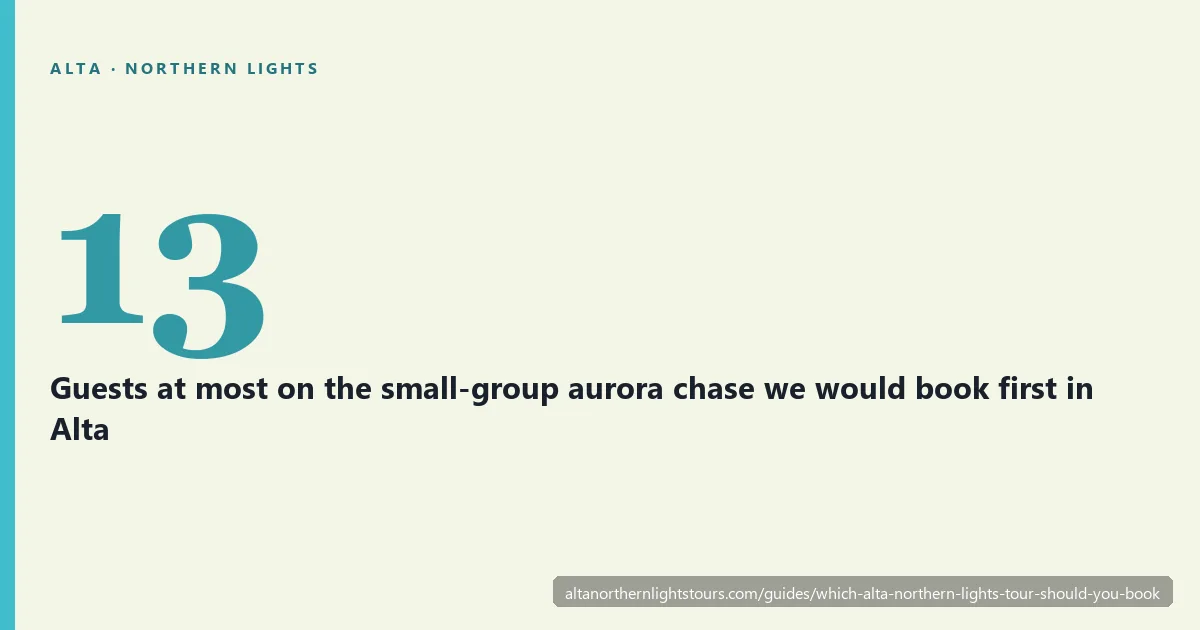
Small-group aurora chase, up to 13
When the season starts and ends
The aurora is there all year. What changes is whether the sky is dark enough to see it. The University of Tromsø’s space-weather observatory says the midnight sun rules out viewing from about mid-April to early September this far north, so the season opens as the nights come back in September.
At the other end, Alta loses fully dark nights around the start of April. On 1 April the sky never gets completely dark, and by mid-March the dark window has already shrunk to about five hours, starting after 21:00. That is why Visit Alta ends the season in “early April” and why late March trips mean late nights.
The tours keep a slightly narrower calendar. On GetYourGuide the 2026–27 aurora tours in Alta start in early November, most from 4 November, and the operators’ own dates decide the rest. Sorrisniva runs its three-hour hunt from September to the end of March, according to Visit Alta, which shows that suppliers set their own seasons.
What time of night to look
The observatory in Tromsø says auroras are usually best seen in the evening between 20:00 and 02:00, while noting they can appear outside that window. NOAA’s space weather service says activity is often strongest in the late evening, near midnight.
That window shapes how the tours run. Luuso Travel’s Northern Lights Tour with Guide and Photos goes out from 19:00 to midnight, Icecube of Aurora starts its Northern Lights Tour after 20:00, and Alta Adventure says its small-group guests are normally back in Alta just over midnight. Eat early: Alta Adventure recommends dinner before the trip.
If you are hunting on your own, step outside every hour or so from about 20:00 and keep going until 01:00 or 02:00 if the sky is clear.
Month by month in Alta
Temperatures are long-term averages at Alta Airport. Dark hours are for the 1st and 15th of each month, rounded, in local time. “Fully dark” means the sun is far enough below the horizon that twilight has gone.
| Month | Daylight | Fully dark sky (about) | Average high / low | What runs |
|---|---|---|---|---|
| September | Nights return after the midnight sun | Lengthening through the month | Not in our sources | Season opens; Sorrisniva’s own hunt starts |
| October | Shortening days | Long evenings by late October | 4.9 °C / -0.1 °C (41 °F / 32 °F) | Cruise calls; GetYourGuide aurora tours not yet running this year |
| November | Sunrise 07:57 on the 1st, last sunrise 25 Nov | 18:01–04:18 on the 1st; 17:19–05:04 on the 15th | 0.3 °C / -5.5 °C (33 °F / 22 °F) | Aurora tours from 4 Nov; dog sledding from 21 Nov; evening snowmobile from 23 Nov |
| December | Polar night, blue twilight at midday | About 16:40 to 06:00 | -1.5 °C / -8.0 °C (29 °F / 18 °F) | Aurora tours nightly; evening Reindeer Ride from 11 Dec; Sorrisniva Igloo Hotel opens 20 Dec |
| January | Polar night until about 16 Jan, sun back 17 Jan | About 16:50–06:10, a little shorter by mid-month | -3.3 °C / -10.2 °C (26 °F / 14 °F) | Aurora tours, dog sledding, snowmobiles; plateau snowmobile safari from 20 Jan |
| February | 4 h 55 min on the 1st, 7 h 20 min by the 15th | 18:05–05:19 on the 1st; 18:54–04:31 on the 15th | -3.6 °C / -10.3 °C (26 °F / 13 °F) | Aurora tours and the full daytime program |
| March | 9.5 to 11.5 hours of day | 19:53–03:29 on the 1st; 21:12–02:07 on the 15th | -0.4 °C / -7.4 °C (31 °F / 19 °F) | Finnmarksløpet starts 5 Mar 2027; igloo hotel to 31 Mar |
| April | Over 14 hours of day | None from about 1 April | 3.7 °C / -2.8 °C (39 °F / 27 °F) | Season ends early in the month |
A few notes the table can’t hold:
September and October. You can see the aurora on a dark, clear evening, and our September and October rows are thin because our sources don’t cover them in detail. The GetYourGuide aurora tours for this winter only open in November, so in autumn you are looking at operators’ own sites or a car.
November. Most tours start in the first week. Daylight drops fast: the sun rises at 07:57 on 1 November and the last sunrise is on 25 November, when it is up for less than an hour. Snowmobile dates on GetYourGuide begin in late November, but snowmobiles may only use marked trails, and when Alta’s trails open depends on snow. Visit Alta’s snowmobile package runs from December to April, which is a safer guide.
December. This is polar night, from 26 November to about 16 January. It is not black all day: Visit Alta notes a blue twilight that brightens the middle of the day. The Sorrisniva Igloo Hotel’s own site says it opens every year from 20 December to 31 March. A search snippet once gave 7 April as the end, so check the booking page if you are going late in the season.
January and February. These are the coldest months, with average lows around -10 °C (14 °F) at the airport. Visit Alta says the plateau inland is colder, sometimes -25 °C or lower. The sun returns on 17 January and daylight then comes back quickly, which gives you time for dog sledding or a daytime snowmobile safari before the evening hunt.
March. Nights are still dark enough, but the dark starts later. The Finnmarksløpet sled dog race, which Visit Alta calls Europe’s longest, starts in Alta city centre on Friday 5 March 2027 (the race program is still being updated). Visit Alta says a snow and ice art festival runs in the centre at the same time; we found no 2027 dates for it.
Cloud is usually what stops you
You need two things on the same night: a sky that is dark and clear enough, and some aurora activity. The Tromsø observatory puts it plainly: “Often the main obstacle for seeing the aurora is the weather.” It also says the sky “does not need to be completely cloudless”, so a broken sky can still work.
Activity is measured by the Kp index, which NOAA describes as a scale from 0 to 9, where 1 is calm and 5 or more is a geomagnetic storm. A higher Kp pushes the aurora oval further south. Alta is close to 70°N, and this far north the lights are often visible on nights with a low Kp. A high Kp under thick cloud shows you nothing.
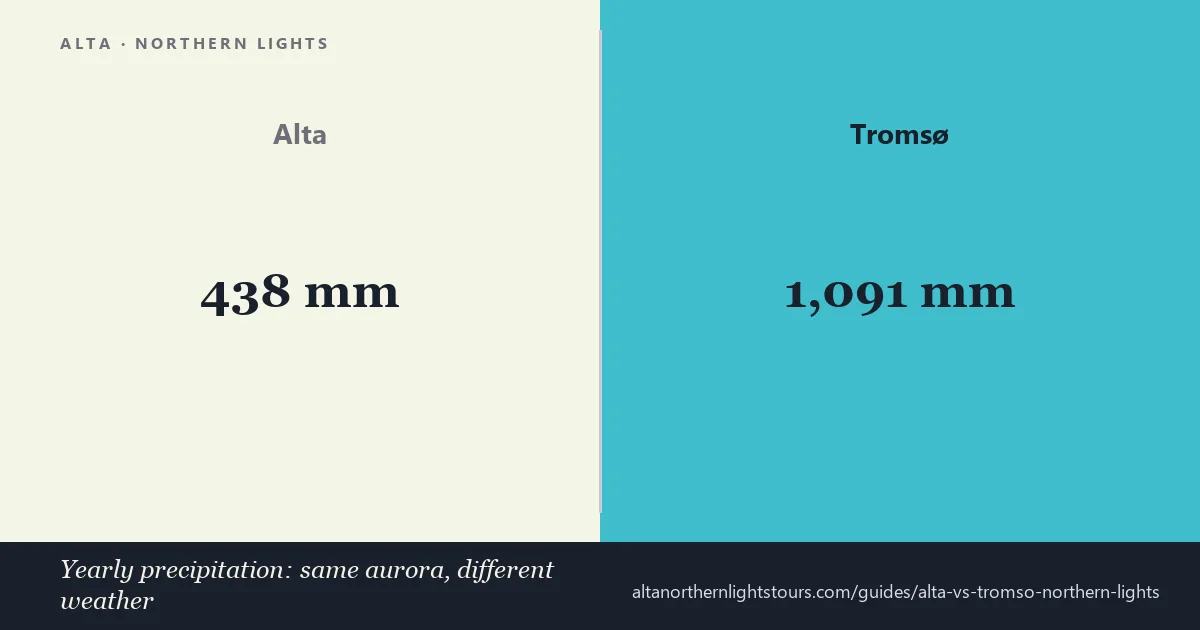
What helps on the ground is that Alta sits inland at the head of a fjord. Its airport station records about 438 mm of precipitation a year, against about 1,091 mm in coastal Tromsø, and Visit Alta says that means more clear nights on average. The guides use that geography too: on a cloudy night they drive inland, along the fjord or up onto the plateau to find a gap. Visit Alta says experienced hunters head either to the Arctic coast or onto the Finnmark Plateau.
Precipitation is not the same thing as cloud, and no source we found gives a clear-night count for Alta. The drier climate improves your chances a little; it guarantees nothing. Every tour listing says the same: Alta Adventure writes that the lights “cannot be guaranteed”.
How many nights should you stay?
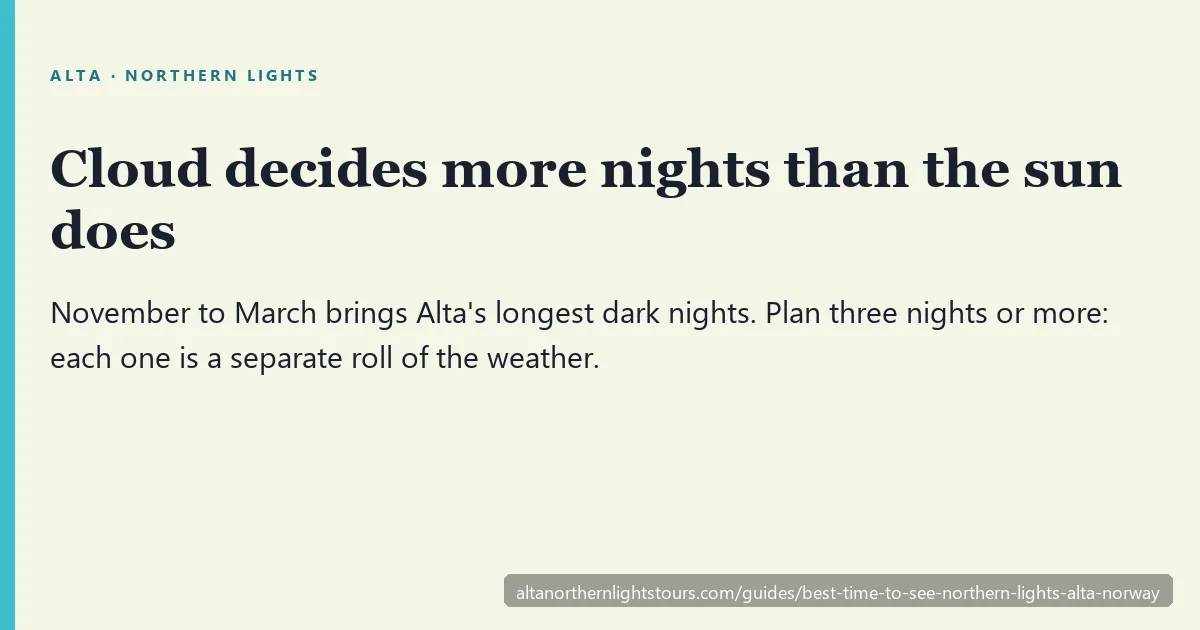
Plan for three nights or more if seeing the aurora is the main reason for the trip.
The reasoning is simple. Each night is a separate roll of the weather. A front that sits over the fjord for one evening may have moved on by the next, and solar activity changes from night to night as well. One night gives you one chance; three nights give you three, and a guide or a forecast can only work with the sky in front of them. We can’t give you a percentage, because no reliable sighting statistic exists for Alta.
Two practical consequences follow. Book your aurora tour for your first or second evening, so that a cloudy night leaves room for a second attempt. Every tour on GetYourGuide in Alta has free cancellation up to 24 hours before, so you can move a booking once the forecast firms up. And keep the other evenings flexible: a car, a lodge outside town or a second tour all give you another look. Our where-to-stay guide covers which bases put you closest to the pickups and furthest from town lights.
Which month should you pick?
If you want the longest dark nights and every winter activity running, January and February give you both, with the cold to match. December suits a polar-night trip and the igloo hotel from 20 December. Early November is the first chance on the tour calendar, with milder weather and some daylight left, but snowmobile trails may not be open yet. March gives you daylight for sledding, the Finnmarksløpet start and later, shorter nights.
For most first-time visitors I would aim for late January to early March, when the sun is back for daytime trips and the nights are still long. If you are comparing destinations as well as dates, our Alta vs Tromsø guide covers weather and access, and the tour guide helps you choose an evening. Our review of the small-group tour covers what a typical night looks like.
Frequently asked questions
What is the best month to see the northern lights in Alta?
Visit Alta calls November to March the best months. For long dark nights with the sun back for daytime trips, late January to early March is a good compromise. December and early January are polar night, and November is milder.
Can you see the northern lights in Alta in October?
Yes, on a dark, clear evening. The season starts in September. The GetYourGuide aurora tours for 2026–27 only start in early November, so in October you need an operator’s own tour or a car.
What time are the northern lights visible in Alta?
The Tromsø observatory says auroras are usually best seen between 20:00 and 02:00, and NOAA says activity is often strongest near midnight. Most Alta tours run from about 19:00 or 20:00 and return around midnight.
Can you see the northern lights in Alta in April?
Only in the first days of the month. By about 1 April the sky no longer gets fully dark, and Visit Alta ends the season in early April.
How many nights do I need in Alta for the northern lights?
Three or more gives you a reasonable number of chances, because each night is a separate weather roll. Book your tour early in the stay so that a cloudy night leaves time to try again.
Pick your night in Alta
Choose a date to see the real price and start time. Free cancellation up to 24 hours before, if the forecast turns.
Check Availability & Book