One of the more telling reviews of an Alta aurora tour comes from a guest who saw nothing on the tour itself. It was snowing, the group drove inland for an hour and a half, and when they got back to the hotel the sky had cleared and the lights were out over the porch. You can see the aurora in Alta without paying anyone, and some nights it comes to you. The catch is that on many nights it does not, and a guide’s main job is driving to where the sky is clear. If you would rather hand that job over, the Northern Lights Bus, run by Finnmark Adventure, a small company based in Alta, costs $149 per person for 3.5 hours on the dates we checked in early November 2026.
Heated-bus aurora hunt, local guides
Can you see the northern lights from Alta town?
Yes, on a strong night. Alta is close to 70°N, and this far north an active aurora can spread across much of the sky. NOAA says a bright aurora can be seen from up to about 1,000 km away, so it does not have to be right above you.
Two things work against you in town. Street and house lights make a faint display hard to see, which is why every tour heads out of the centre; Icecube of Aurora says its tour travels “to locations with minimal light pollution”. And the sky over town can be cloudy while it is clear further away. Alta Adventure notes that “pictures often show the colors of the northern lights stronger than how they are seen with the naked eyes”, so a faint glow over town may look pale to you and much greener on your phone.
If your hotel is outside the centre, step outside every hour or so from about 20:00 to 02:00, which the University of Tromsø’s observatory gives as the usual best window. Our where-to-stay guide covers the river valley and Gargia lodges, away from town lights.
What you need
A car is the main thing. Without one you are limited to what you can see from where you are sleeping. With one you can drive towards the clear sky, which is what the guides do. One travel blogger who hunted in Alta recommends a car precisely so you can “change course quickly”.
A forecast that shows cloud. The aurora forecast tells you whether there may be activity; the weather forecast tells you whether you will see it. You need both, and the cloud forecast is the one that more often decides the night.
Proper winter clothes. Alta Airport’s average lows in January and February are around -10 °C (14 °F), and Visit Alta says the plateau inland can reach -25 °C or lower. On an aurora hunt you stand still for long stretches. Alta Adventure advises “very warm layers, preferably wool”, and Tyri Adventures suggests a wool base layer, a warm hat, gloves or mittens, a neck warmer and a winter jacket. Add insulated winter boots.
A tripod if you want photographs. Photography guides usually suggest manual mode, the widest aperture, a starting ISO of about 3200, exposures of a few seconds, focus set to infinity and the flash off. Treat these as a starting point and take test shots.
How to read the forecast
Start with the cloud. On yr.no, Norway’s national weather service app, look at the hourly forecast for where you plan to drive, and check the low and mid-level cloud as well as the overall figure if the detailed view shows it. Yr also has an aurora forecast up to three days ahead and a short-term nowcast for the next 30 to 90 minutes, shown next to the cloud cover. Visit Alta links an Alta aurora forecast from its northern lights page.
Then look at activity. NOAA’s Kp index runs from 0 to 9, with 1 calm and 5 or more a geomagnetic storm. A higher number means the aurora oval spreads further south. In Alta you don’t need a storm: this far north the lights are often visible on nights with a low Kp. NOAA’s 30-minute aurora forecast is a model of where the aurora is likely to be in the next 30 to 90 minutes, and NOAA calls its viewing probability an approximation.
Put them together like this:
- Clear sky and any activity: go out.
- Some cloud with gaps and decent activity: go out and be ready to move.
- Thick cloud everywhere nearby, whatever the Kp: stay in, or drive only if the forecast shows a clear area within reach.
The Tromsø observatory says the sky “does not need to be completely cloudless”, and that “often the main obstacle for seeing the aurora is the weather”. Inland and coastal weather can differ on the same night, and Visit Alta says experienced hunters head either to the Arctic coast or up onto the Finnmark Plateau.
What makes a good spot
We don’t list named viewing spots, because we found no reliable source for any, and a pull-off that works on one night may be under cloud the next. Look for these instead:
- Dark. The further you are from the lights of town, the fainter the aurora you can see.
- A wide view of the sky. The more sky you can see, the more of a display you catch. A spot hemmed in by trees or a steep slope hides a lot; open ground or a hillside looking north gives you more sky.
- Safe parking. Pull off only where there is real space, away from bends and junctions, with your car fully off the road. Don’t block farm tracks, driveways or snow-plough turning areas.
- Somewhere to retreat. You will spend a long time standing still in the cold, so a spot close to the car is better than a long walk in the dark.
Stay on the roads. Norway’s law on motor traffic in uncultivated land bans motorised traffic on uncultivated land and frozen water unless the rules allow it, so don’t drive out onto open snow or a frozen lake. Snowmobiles may only use marked trails.
Driving at night in winter
Visit Norway’s winter driving advice applies directly to an aurora drive:
- Make sure the car has winter tyres; rental cars carry them as standard in the cold season. Studded tyres are allowed in Finnmark from 16 October to 30 April.
- Keep your headlights on at all times.
- Expect reindeer and moose on the road. The risk is greatest in autumn and winter.
- Mountain roads can close, or run in convoys, in bad weather. Check before you head up onto the plateau.
The dark adds its own risks. You are driving on snow, often tired, late at night, with your eyes on the sky. Pick your spot before you set off and stop properly to look up.
When a tour pays off
A tour makes more sense than going it alone if any of these apply:
- You have no car. The tours collect from town and drive you to the clear sky. Visit Alta says guided hunts that go to the clearest sky give the best odds.
- You have only one or two nights. A guide who reads the cloud forecast for a living gets more out of a short stay than a first-timer with a map.
- The forecast is mixed. On a night of patchy cloud the guides’ local knowledge counts for most. One reviewer of the fire-and-photos tour describes a drive of about an hour to perfectly clear skies while the cruise port was under heavy cloud.
- You don’t want to drive on snow at night, or you want warm clothing provided. Several tours lend thermal suits.
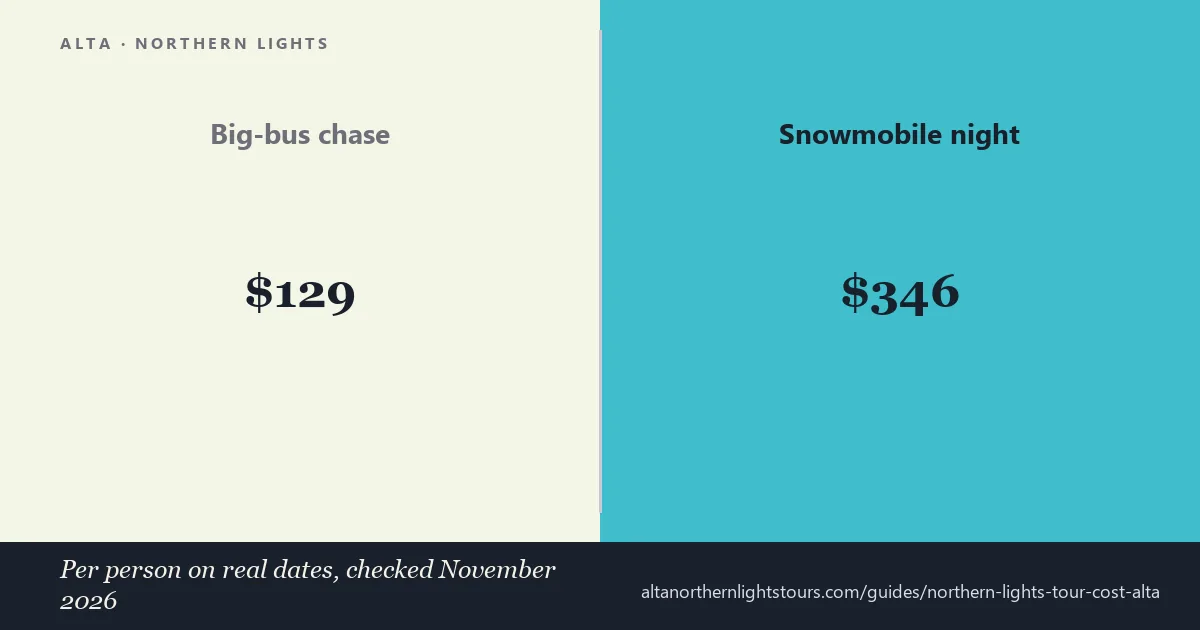
The Northern Lights Bus is 3.5 hours in a heated bus with a local guide and an aurora presentation, from $149 per person on 4 November 2026, rated 4.4 from 56 reviews. For six guests or fewer, Finnmark Adventure says it runs the evening by car. It does not include photography help, so bring your own settings. Our review of the Northern Lights Bus →
If you want photos taken for you, the Northern Lights Adventure Tour with Fire & Free Photos was $129 per person on 13 November 2026, with free professional photos and a campfire. Our cost guide compares every evening tour, and the tour guide helps you pick one.
A good plan for three or four nights is to book a tour for the first or second evening, then hunt on your own on the others. All the tours we list have free cancellation up to 24 hours before, though none refunds you if the lights simply don’t appear.
Frequently asked questions
Can you see the northern lights in Alta without a tour?
Yes, on clear nights with some activity, and sometimes from your hotel. A car, a cloud forecast and a dark spot with a wide view of the sky improve your chances a lot.
Can you see the northern lights from Alta town centre?
On strong nights, yes, but town lights hide fainter displays. A short drive out of the centre makes a big difference.
What Kp do you need to see the northern lights in Alta?
There is no fixed number. Alta is close to 70°N, where the lights are often visible on nights with a low Kp. Cloud cover usually decides more than Kp does.
Where is the best place to see the northern lights in Alta?
We don’t name spots, because we found no reliable source for any and the clear sky moves from night to night. Look for somewhere dark, with a wide view of the sky and safe parking off the road.
Do I need to rent a car in Alta for the northern lights?
Not if you book a tour, since the tours collect you in town. To hunt on your own, a car is close to essential.
Pick your night in Alta
Choose a date to see the real price and start time. Free cancellation up to 24 hours before, if the forecast turns.
Check Availability & Book